Shigeru Ban Wood Structure: Innovation, Humanity, and Engineering Elegance
The work of Shigeru Ban has redefined how wood is perceived and used in modern architecture. Renowned for combining structural innovation with social responsibility, Ban’s wood structures challenge conventional ideas of permanence, cost, and material hierarchy. His projects demonstrate that timber—when used intelligently—can be expressive, resilient, and profoundly humane.
We have completed hundreds of civil and structural design spreadsheets, including all aspects of structural timber design. Follow the link for further details and offers.
A Philosophy Rooted in Material Honesty
Shigeru Ban’s approach to wood structure is guided by a belief in material honesty and accessibility. Rather than using wood purely for aesthetics, he explores its full structural potential—often in unconventional ways—while emphasizing simplicity, efficiency, and dignity.
His philosophy is shaped by several core ideas:
- Architecture should serve people, especially in times of crisis
- Materials should be used responsibly and creatively
- Structural systems should be legible and expressive
Wood, with its versatility and renewability, is central to this vision.
Wood as Structure, Not Just Finish
In Shigeru Ban’s architecture, wood is rarely superficial. Timber members are often:
- Primary load-bearing elements
- Exposed and celebrated
- Organized into clear, repetitive structural systems
By revealing how forces flow through a building, Ban turns structure itself into architectural language.
Signature Timber Structural Strategies
Large-Span Timber Systems
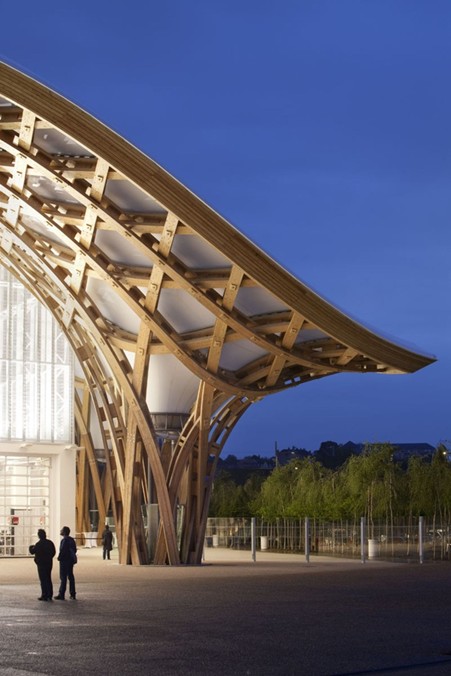
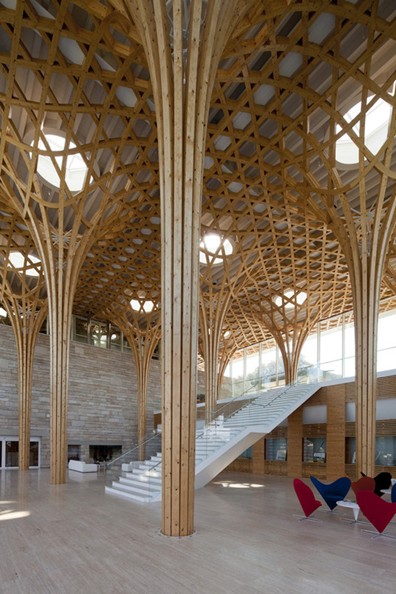
Ban frequently uses engineered timber—such as glulam and laminated wood assemblies—to achieve wide, column-free spaces. These systems rival steel in performance while offering warmth and lightness.
Modular and Repetitive Elements
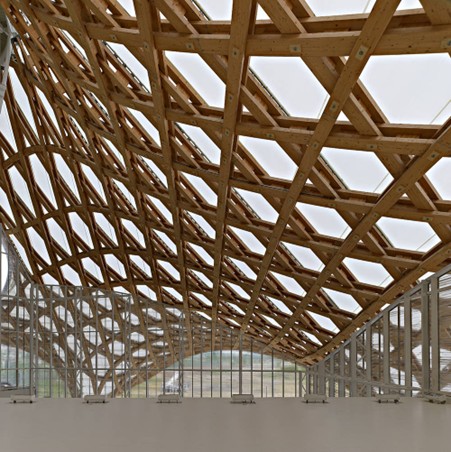
Many of his wood structures rely on repeated members arranged in grids, arches, or lattices. This modularity improves constructability, reduces waste, and enhances structural clarity.
Hybrid Wood Construction
Shigeru Ban often combines timber with discreet steel components to optimize strength and connection performance while keeping wood visually dominant.
Iconic Projects Featuring Wood Structure
Several of Shigeru Ban’s most influential projects highlight his mastery of timber engineering:
- Centre Pompidou-Metz – A dramatic timber roof structure inspired by woven forms, demonstrating wood’s capability at monumental scale
- Swatch Headquarters – One of the world’s largest timber grid-shell structures, showcasing advanced digital fabrication and engineering
- Museums, halls, and pavilions that use exposed wood frames to shape space and light
In each case, the structure is inseparable from the architectural identity.
Humanitarian Architecture and Temporary Wood Structures
Beyond landmark buildings, Shigeru Ban is widely known for humanitarian work using wood and paper-based systems. His temporary shelters and community buildings emphasize:
- Rapid construction
- Low cost and local materials
- Structural adequacy without excess
These projects prove that wood structures can be both technically sound and socially transformative.
Sustainability and Environmental Responsibility
Shigeru Ban’s wood structures align strongly with sustainable design principles:
- Reduced embodied carbon compared to steel or concrete
- Efficient use of material through structural optimization
- Adaptability and potential for reuse
For Ban, sustainability is not a stylistic choice—it is an ethical responsibility.
Influence on Contemporary Timber Architecture
Shigeru Ban’s work has had a lasting impact on global timber design by:
- Expanding acceptance of large-scale wood structures
- Inspiring innovation in mass timber engineering
- Demonstrating that structural ambition and environmental responsibility can coexist
His projects continue to influence architects, engineers, and students worldwide.
Final Thoughts
Shigeru Ban’s wood structures stand at the intersection of engineering innovation, architectural beauty, and human-centered design. By pushing timber beyond tradition and into new structural territories, he has shown that wood can be monumental without being heavy, innovative without being wasteful, and powerful without losing its humanity.


