Laminate Stiffness Matrix: The Backbone of Composite Structural Analysis
The laminate stiffness matrix is a fundamental concept in composite materials engineering. It forms the mathematical foundation used to predict how laminated composite structures—such as carbon fiber panels, fiberglass shells, and engineered laminates—respond to mechanical loads.
Whether you’re designing aerospace components, marine structures, wind turbine blades, or advanced architectural systems, understanding the laminate stiffness matrix is essential for accurate structural analysis and efficient design.
We have completed hundreds of civil and structural design spreadsheets, including all aspects of structural timber design. Follow the link for further details and offers.
What Is the Laminate Stiffness Matrix?
In laminated composites, individual layers (plies) are stacked with different material properties and fiber orientations. Instead of behaving like a single isotropic material, the laminate exhibits complex, direction-dependent behavior.
The laminate stiffness matrix captures this behavior by relating:
- Forces and moments applied to the laminate
- Mid-plane strains and curvatures that result
This relationship is commonly expressed through the ABD matrix, which combines three key stiffness components.
The ABD Matrix Explained
The laminate stiffness matrix is written as:
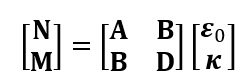
Where:
- N = in-plane force resultants
- M = bending moment resultants
- ε⁰ = mid-plane strains
- κ = curvatures
Each submatrix has a distinct physical meaning.
A Matrix – Extensional Stiffness
The A matrix describes the laminate’s resistance to in-plane forces (tension and compression). It governs how the laminate stretches under loads applied within the plane.
B Matrix – Bending–Stretching Coupling
The B matrix represents coupling between bending and stretching.
- If B = 0, bending does not cause in-plane stretching, and vice versa
- If B ≠ 0, bending induces stretching and stretching induces bending
Symmetric laminates naturally eliminate this coupling, making the B matrix zero.
D Matrix – Bending Stiffness
The D matrix defines resistance to bending and curvature. It plays a role similar to the second moment of area in classical beam theory but extended for anisotropic laminated materials.
How the Laminate Stiffness Matrix Is Formed
The stiffness matrix is assembled by:
- Computing the transformed stiffness matrix of each ply based on its material properties and fiber orientation
- Integrating these stiffness contributions through the laminate thickness
- Summing the effects of all plies to form the global A, B, and D matrices
Because ply orientation and stacking sequence matter, two laminates with the same materials but different layups can have dramatically different stiffness behavior.
Why the Laminate Stiffness Matrix Matters
The laminate stiffness matrix allows engineers to:
- Predict deformation under complex loading
- Design laminates with tailored directional stiffness
- Avoid undesirable bending–stretching coupling
- Optimize weight, strength, and performance
It is central to classical laminate theory and is used extensively in finite element analysis and structural optimization.
Symmetric vs. Unsymmetric Laminates
- Symmetric laminates:
- B matrix = 0
- Easier to analyze and manufacture
- Common in aerospace and high-performance applications
- Unsymmetric laminates:
- B matrix ≠ 0
- Can warp or twist under load
- Sometimes intentionally designed for specialized behavior
Understanding the stiffness matrix helps engineers choose the appropriate configuration.
Practical Applications
Laminate stiffness matrices are used in:
- Aerospace panels and fuselage skins
- Marine hulls and decks
- Wind energy structures
- Automotive composite components
- High-performance sporting equipment
Any structure relying on layered composites depends on this formulation for safe and efficient design.
Final Thoughts
The laminate stiffness matrix is the cornerstone of composite structural mechanics. By linking material properties, ply orientations, and laminate geometry into a unified framework, it enables precise prediction and control of structural behavior. Mastery of this concept empowers engineers to design lighter, stronger, and more efficient composite structures across a wide range of industries.


