Filter strip design requires careful analysis of rainfall volumes and detailed hydraulic calculations. Flowing through urban and sub-urban areas detailed design is essential to ensure that heavy rainfall does not produce dangerous deep or high velocity flows which can present a danger to residents.
The CivilWeb Filter Strip Design Spreadsheet can save hours of repetitive calculations while ensuring compliance with CIRIA C753 SUDS Manual in the UK, CSIRO 1999 in Australia or MSMA in Malaysia, reliable accuracy and even optimisation tools which can save money on materials during the construction phase.
The CivilWeb Filter Strip Design Spreadsheet can be purchased lower down this page for only £19.99. Or why not buy our best value bundle? Our Full Drainage Design Spreadsheet Suite can be purchased at the bottom of this page for only £49.99. This suite includes all of our drainage design spreadsheets, more than 20, and represents an incredible saving of more than 85%.
Please click here for the Australian version of this page.
What is a Filter Strip?
A filter strip is a gently sloping, vegetated surface designed to slow down stormwater runoff and remove pollutants before the water enters a downstream drainage feature such as a swale, basin, wetland, or watercourse. Unlike a channel, a filter strip is broad and shallow, encouraging water to spread out into a thin sheet rather than concentrating into a flow path.
Filter strips are commonly installed along:
- Roads and highways
- Car parks and driveways
- Industrial yards
- Pathways and landscaped areas
- Watercourse edges
Their vegetation—often grasses or meadow mixes—helps trap sediments, absorb nutrients, and promote infiltration. By slowing the water and filtering it through soil and plant roots, filter strips improve water quality and reduce the hydraulic load on downstream systems.
Key benefits include:
- Reduced sediment and pollutant transport
- Lower peak runoff entering SuDS features
- Enhanced biodiversity and landscape value
- Low maintenance and long service life
- Compliance with SuDS and water‑quality regulations
Common Filter Strip Design Methods
Designing a filter strip involves ensuring that runoff spreads evenly, flows slowly, and has enough contact time with vegetation and soil to achieve meaningful treatment. Several established methods are widely used:
Sheet Flow Design — The filter strip is graded to maintain shallow, uniform sheet flow. Designers calculate the maximum allowable slope and length to prevent water from concentrating into rills or channels.
Hydraulic Residence Time Method — The strip is sized to ensure runoff remains on the surface long enough for sediment deposition and infiltration. This often involves calculating flow velocity using Manning’s equation.
Vegetation‑Based Treatment Design — Plant selection is tailored to the pollutants expected. Dense grasses are effective for sediment removal, while deeper‑rooted species can improve infiltration and nutrient uptake.
Pretreatment and Flow Spreading — Features such as level spreaders, kerb cuts, or perforated edges help distribute water evenly across the strip. This prevents erosion and improves treatment efficiency.
Infiltration‑Enhanced Design — Where soils allow, filter strips are designed to infiltrate a portion of the runoff. Soil testing determines infiltration rates and the required strip width.
Each method must consider rainfall intensity, contributing catchment area, soil type, slope, vegetation type, and maintenance access to ensure long‑term performance.
How Does the CivilWeb Filter Strip Design Spreadsheet Work?
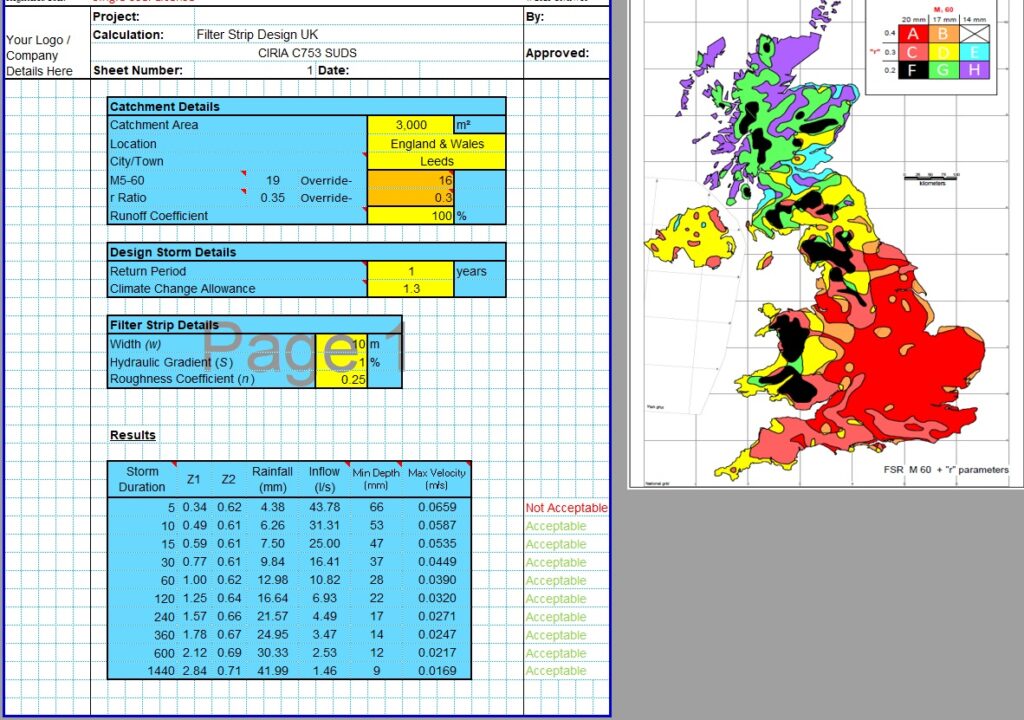
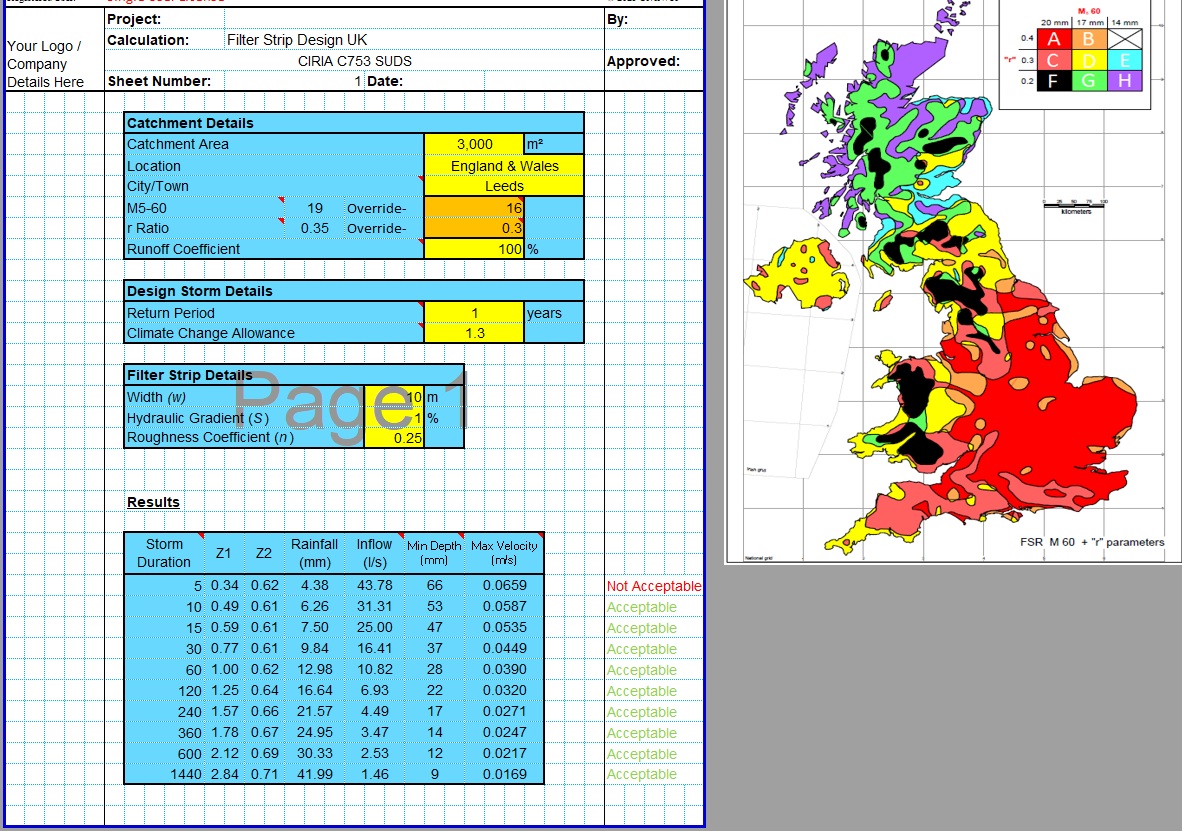
Firstly the spreadsheet calculates the quantity of rainwater that the filter strip will be required to handle. The spreadsheet is pre-loaded with rainfall data for all parts of the UK, so the user simply needs to input the location, runoff coefficient, return period and climate change factor. The spreadsheet uses this info to calculate the rainfall intensity, which is simply multiplied by the catchment area to give the total volume of water for all possible design storm events.
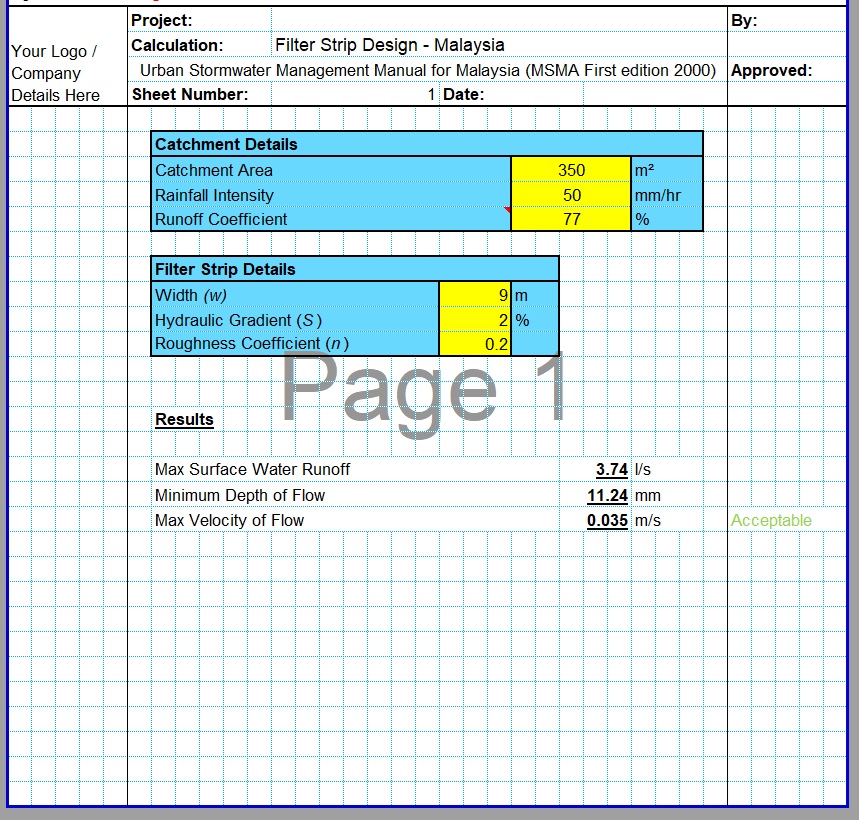
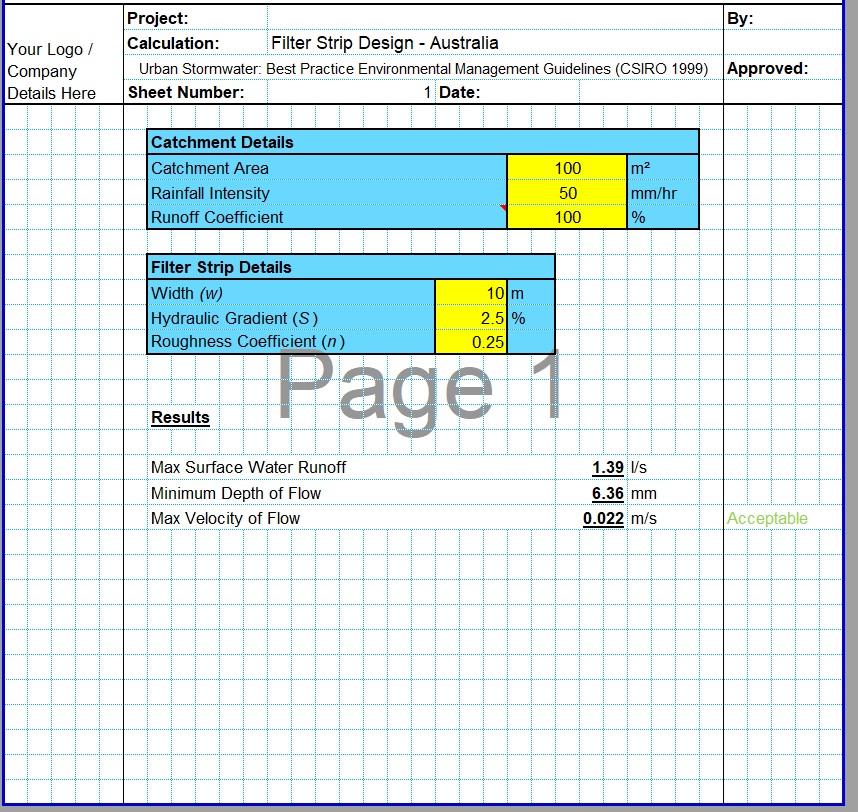
The Australian and Malaysian versions of the spreadsheet use a simple rainfall intensity to calculate the rainfall volumes and flow rates. All versions of the spreadsheet (UK, Australian and Malaysian) are delivered together, there is no need to purchase multiple versions.
Finally the user can input the dimensions of the filter strip to be analyzed. This includes the width, gradient and Manning roughness coefficient of the proposed channel.
With all these inputs made, the spreadsheet cleverly analyses each potentially critical design storm event and calculates the inflow into the filter strip and uses this to calculate the depth of flow and the maximum flow velocity through the swale. The spreadsheet also checks these values to ensure that they are in accordance with the relevant standards. This ensures that the swale cannot present any dangers during operation which is important as they are often used in heavily populated areas and housing projects where fast or deep flows could potentially endanger life during storm events.
With all checks completed, the user can clearly see whether the proposed filter strip is acceptable and in accordance with the relevant design standards or whether it needs to be adjusted.
Why Use a Filter Strip Design Spreadsheet?
A filter strip design spreadsheet helps engineers manage the many variables involved in sizing and checking the system. Because filter strips rely on hydraulics, vegetation performance, and soil infiltration, a spreadsheet ensures calculations are accurate, consistent, and easy to update.
Advantages include:
- Automated calculations for flow velocity and depth
- Quick comparison of different slopes and rainfall events
- Scenario testing for alternative layouts or catchment sizes
- Clear documentation for planning submissions and SuDS compliance
For developers, engineers, and local authorities, a spreadsheet becomes a practical tool that reduces design time and increases confidence that the filter strip will perform effectively in real‑world conditions.
Get Started Today
Save hours of repetitive calculation time. Whether you’re working on a major project or a small renovation, this tool will give you clarity, accuracy, and confidence.
Buy the CivilWeb Filter Strip Design Spreadsheet now for only £19.99.
Or alternatively big savings are available with our Swale and Filter Strip design bundle. Get both spreadsheets for only £29.99.
Or why not bundle with the CivilWeb Swale Design Spreadsheet for only £10 extra?
Or save £300+ by buying our full Drainage Design Suite including all our drainage design spreadsheets.
Free Trial Version
Why not try the fully functional free trial version of this spreadsheet?
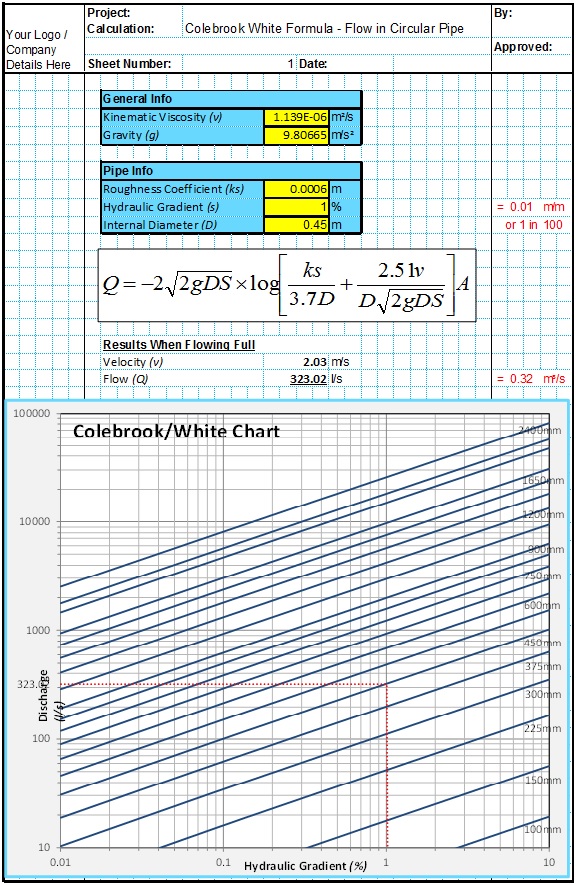
PIPE FLOW CALCULATOR
This spreadsheet uses the Colebrook-White and Manning Equations to calculate the flow capacity and velocity in pipes acting under gravity.
Find Out More
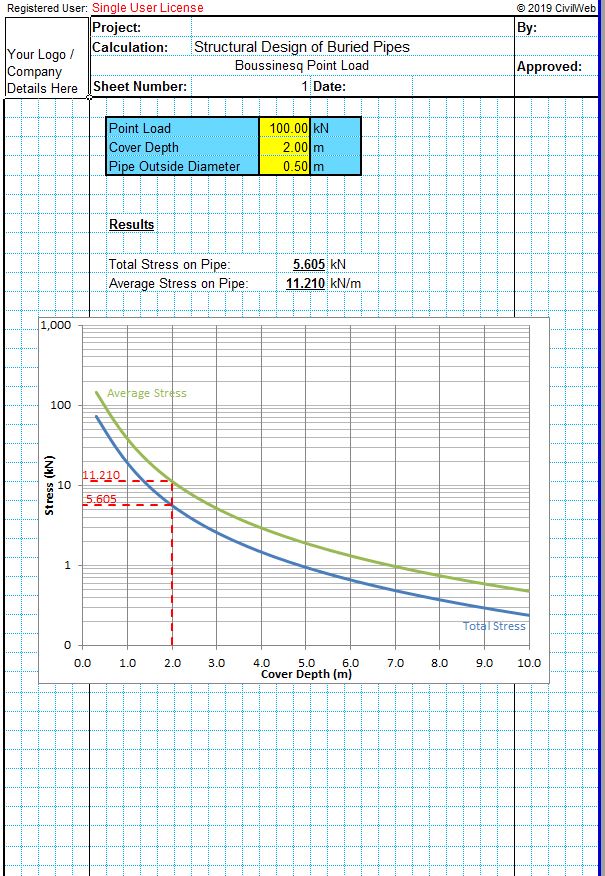
Buried Pipe Design Spreadsheet
This spreadsheet can be used to design concrete, steel, plastic and other buried pipes in accordance with BS EN 1295-1.
Learn More
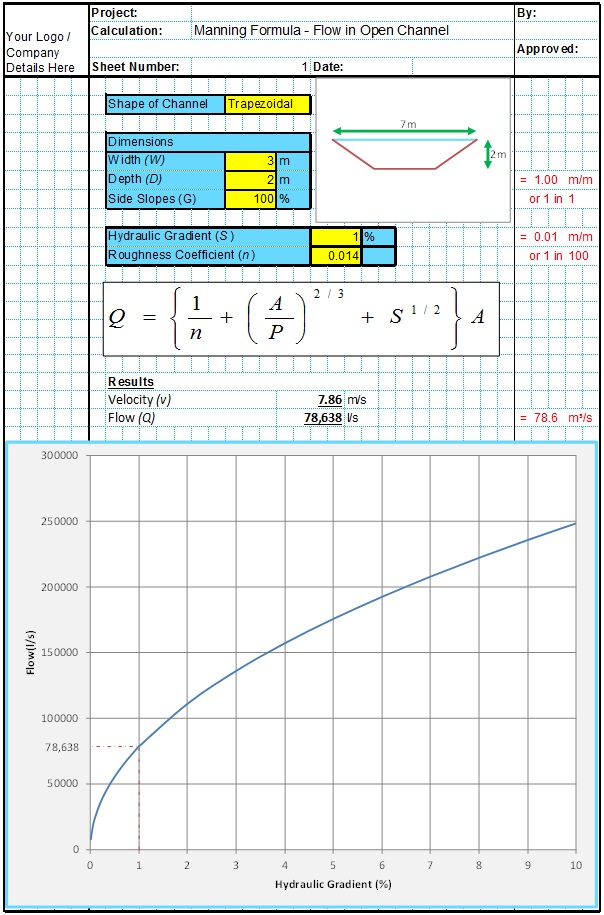
Manning Open Channel Design Spreadsheet
This spreadsheet uses the Manning formula to calculate the flow conditions in an open channel acting under gravity only.
Learn More
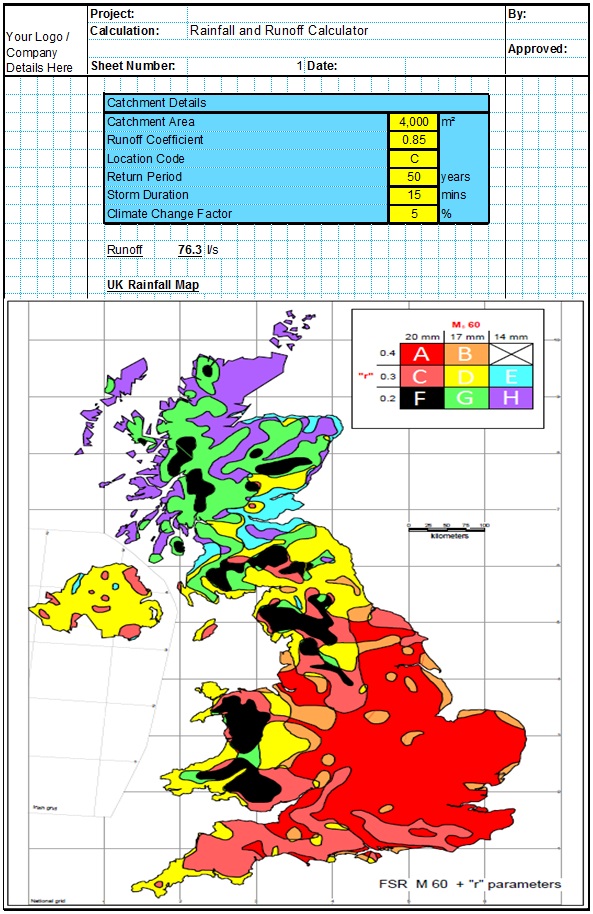
Runoff Calculator Spreadsheet
This spreadsheet calculates the design runoff flow for a site in accordance with the Flood Estimation Handbook.
Learn More
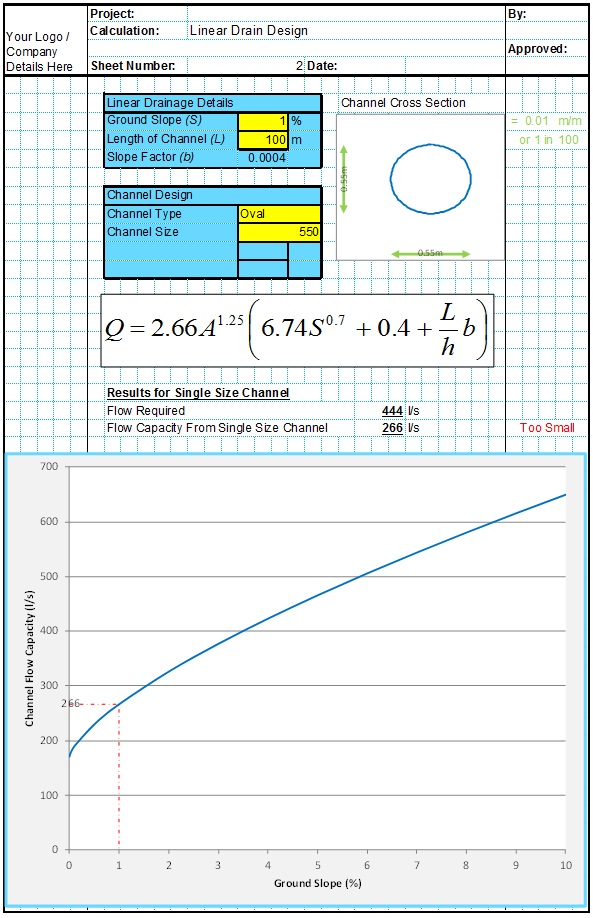
Linear Drainage Design Spreadsheet
This spreadsheet calculates the maximum flow from a specified linear drainage channel and checks whether the channel is sufficient for the specified site and storm conditions.
Learn More
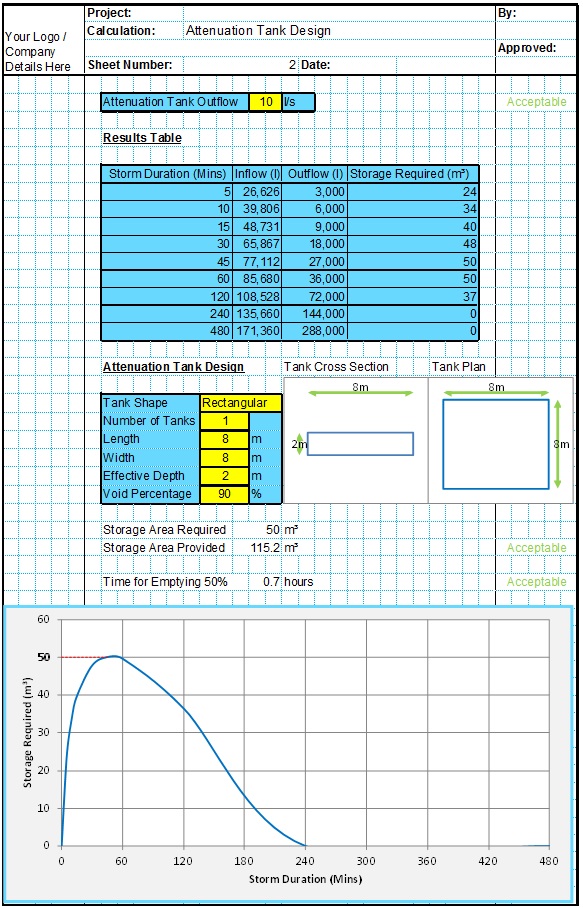
Attenuation Design Spreadsheet
This spreadsheet calculates the requirements for a attenuation system and assists the user to design a suitable system.
Learn More
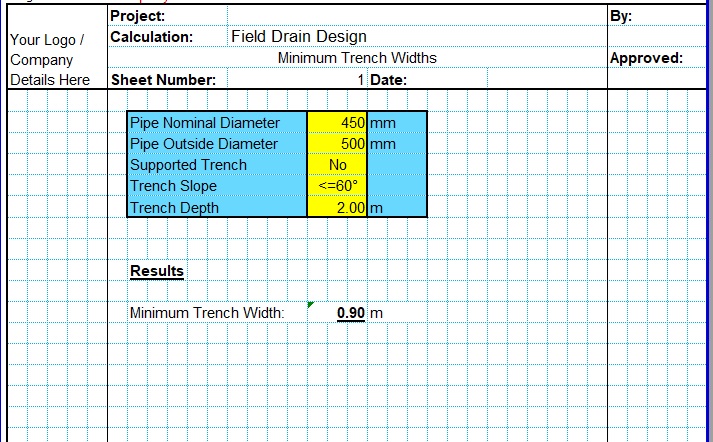
Field Drain Design Spreadsheet
This spreadsheet can be used to design field drains, typically subsurface drainage systems used to drain fields and open areas.
Learn More
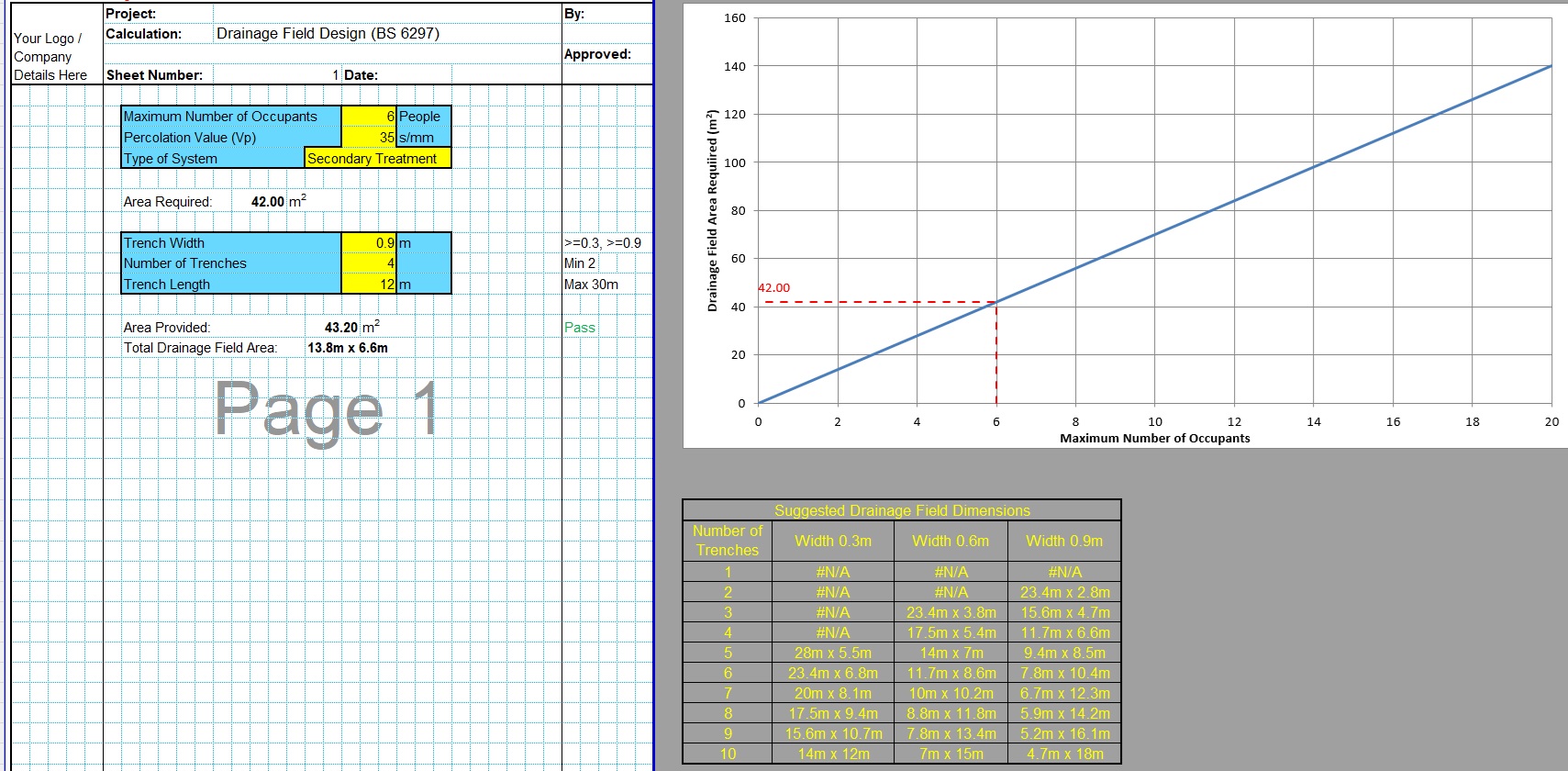
Drainage Field Design Spreadsheet
This spreadsheet can be used to design septic infiltration systems known as drainage fields, leach fields or septic drain fields.
Learn More
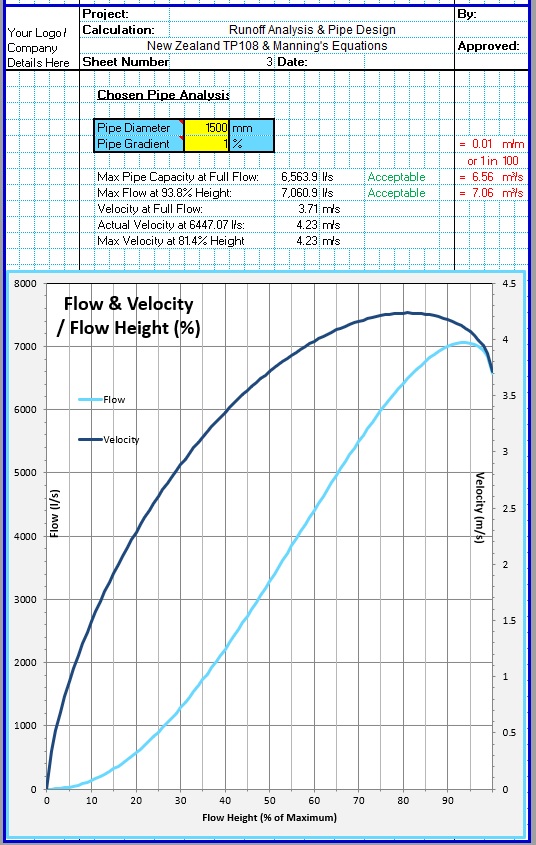
TP108 Spreadsheet
This spreadsheet calculates the rainfall for New Zealand catchments in accordance with TP108.
Learn More
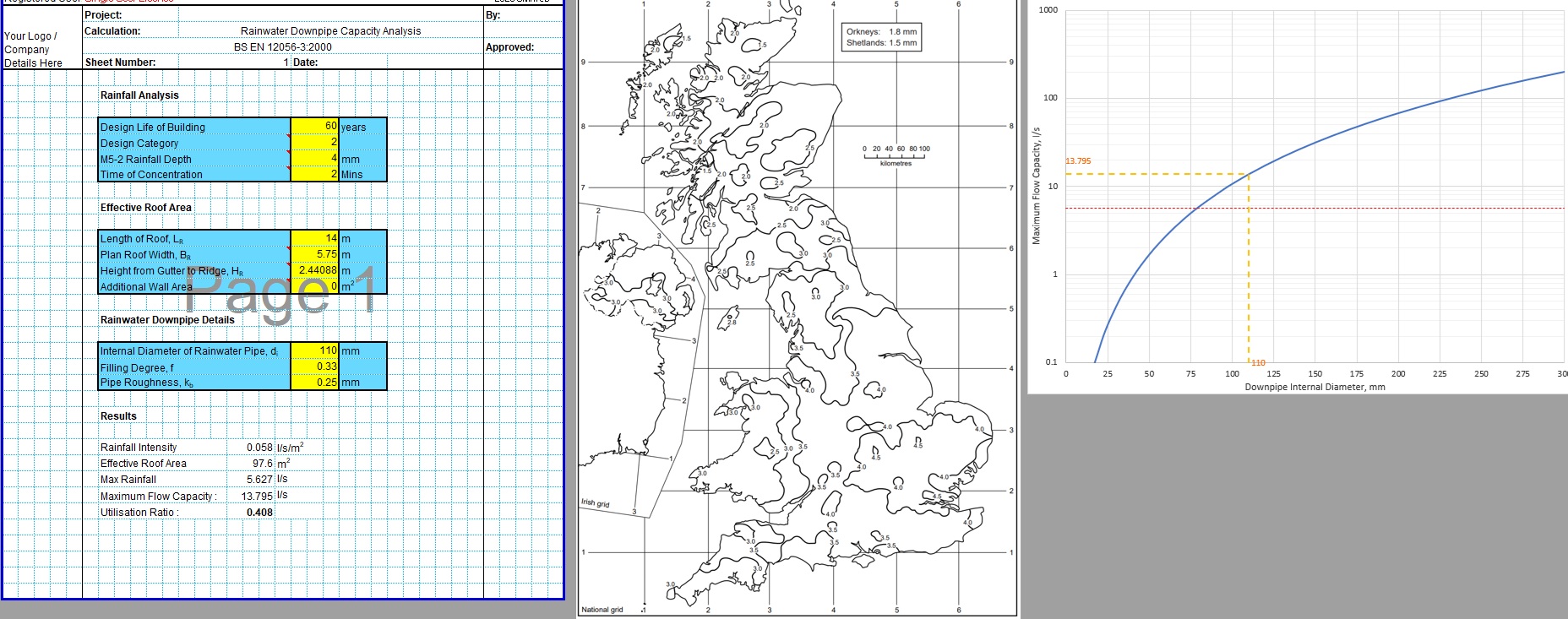
Roof Downpipe Calculator Spreadsheet
This spreadsheet calculates the size of roof drainage downpipes depending on the roof catchment and rainfall requirements.
Learn More
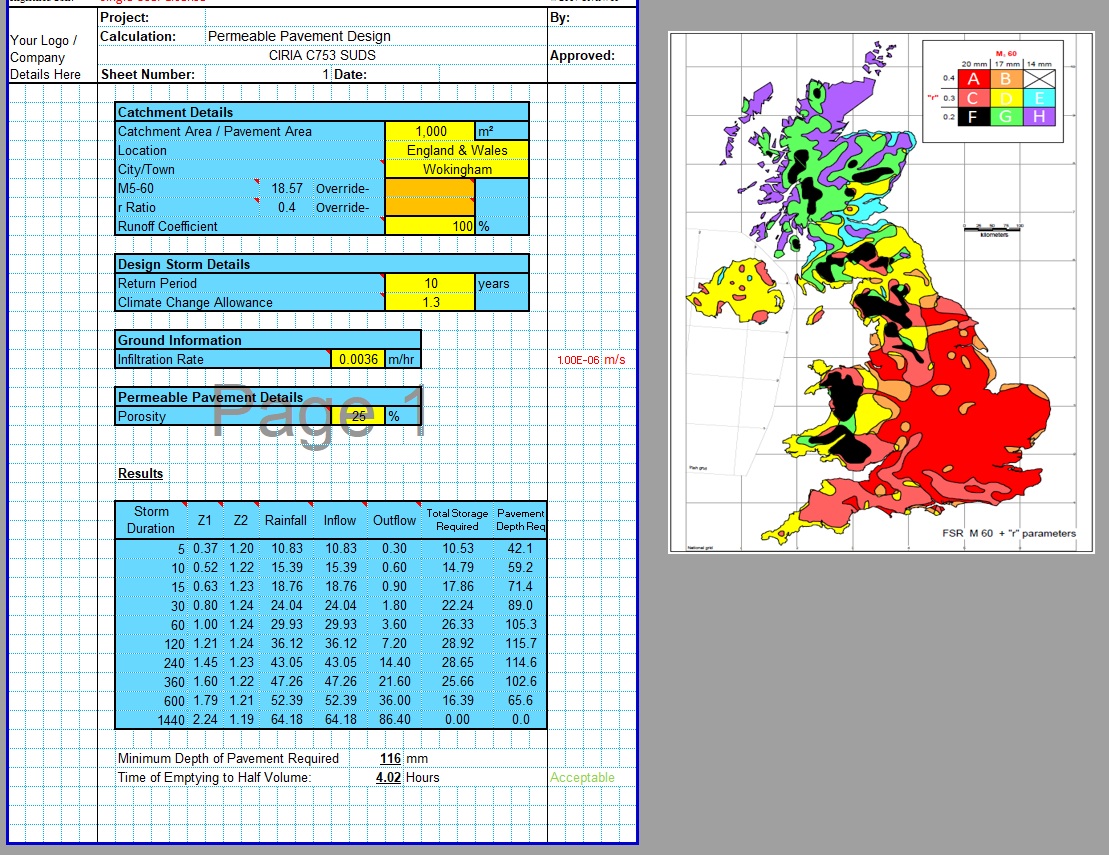
Permeable Pavement Design Spreadsheet
This spreadsheet is designed to determine the size and characteristics of permeable pavements.
Learn More
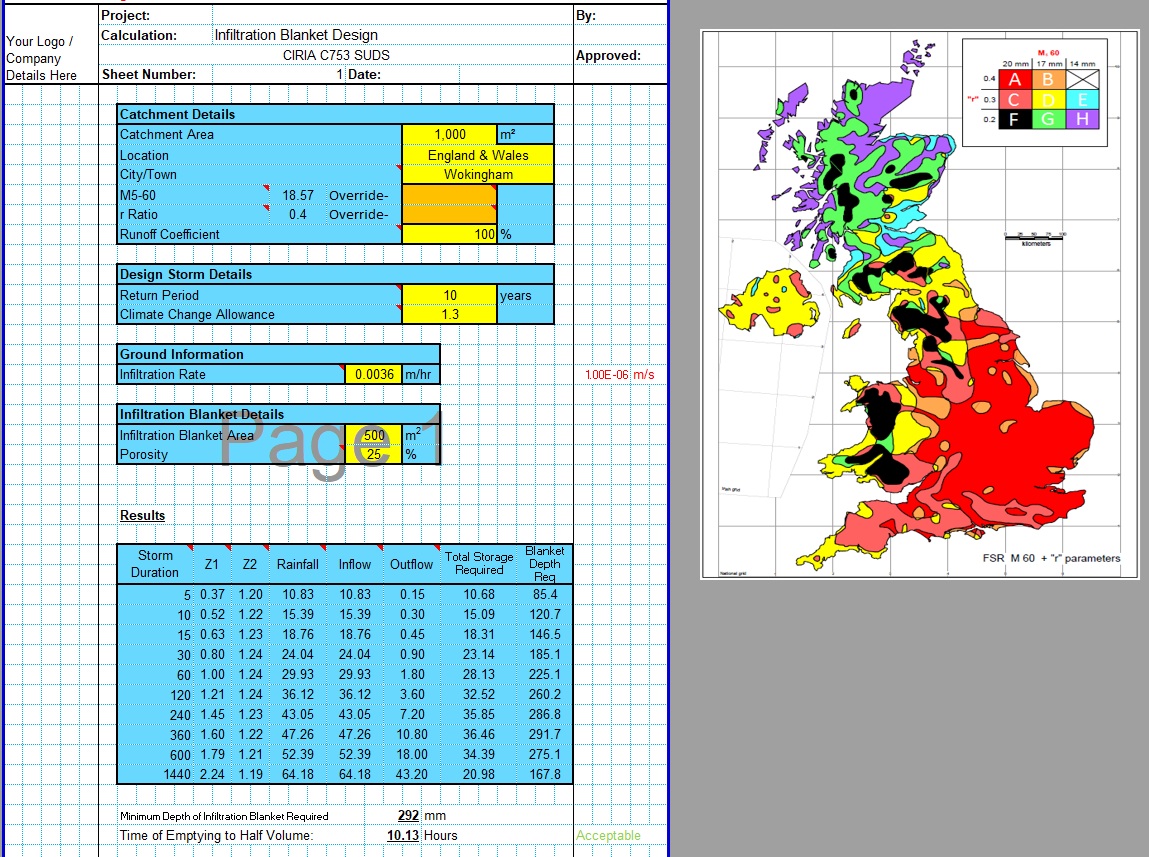
Infiltration Blanket Design Spreadsheet
This spreadsheet can be used to design thin depth infiltration systems, typically called infiltration blanket systems.
Learn More
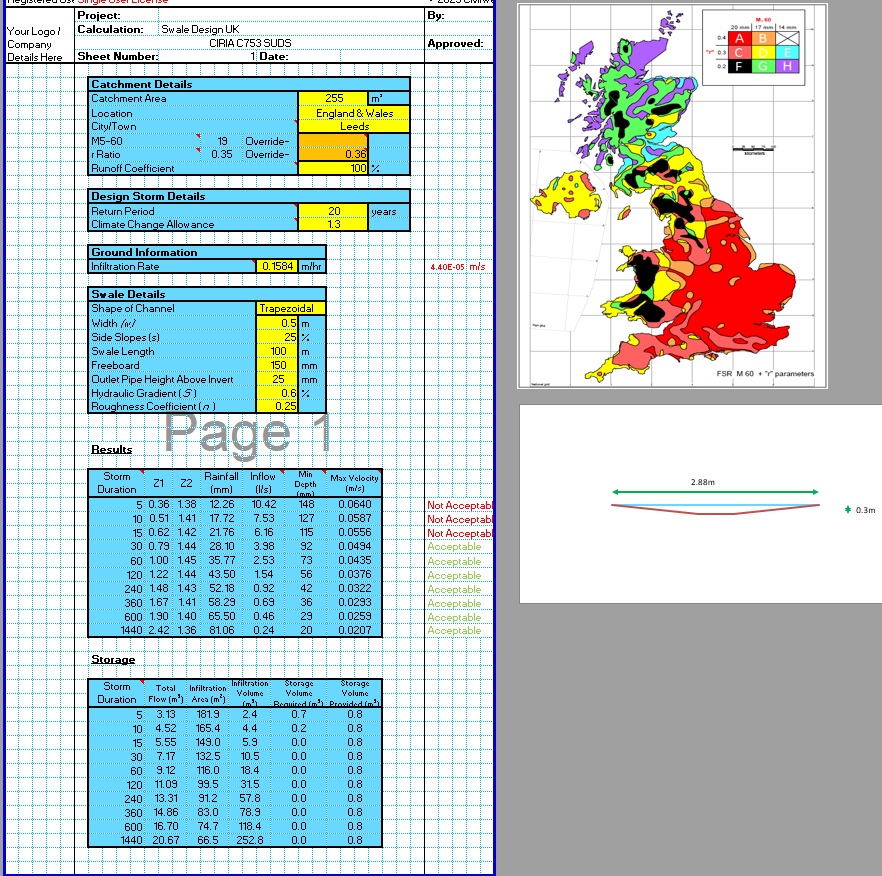
Swale Design Spreadsheet
This spreadsheet can be used to design swales. These linear grassed channels can be used both to convey, infiltrate and filter surface drainage runoff.
Learn More
Filter Strip Design Spreadsheet
This spreadsheet is designed to analyse surface water filter strips and to determine the max flow depth and max flow velocity and determine whether they are in accordance with relevant standards.
Learn More
Hydraulic Gradient Analysis Spreadsheet
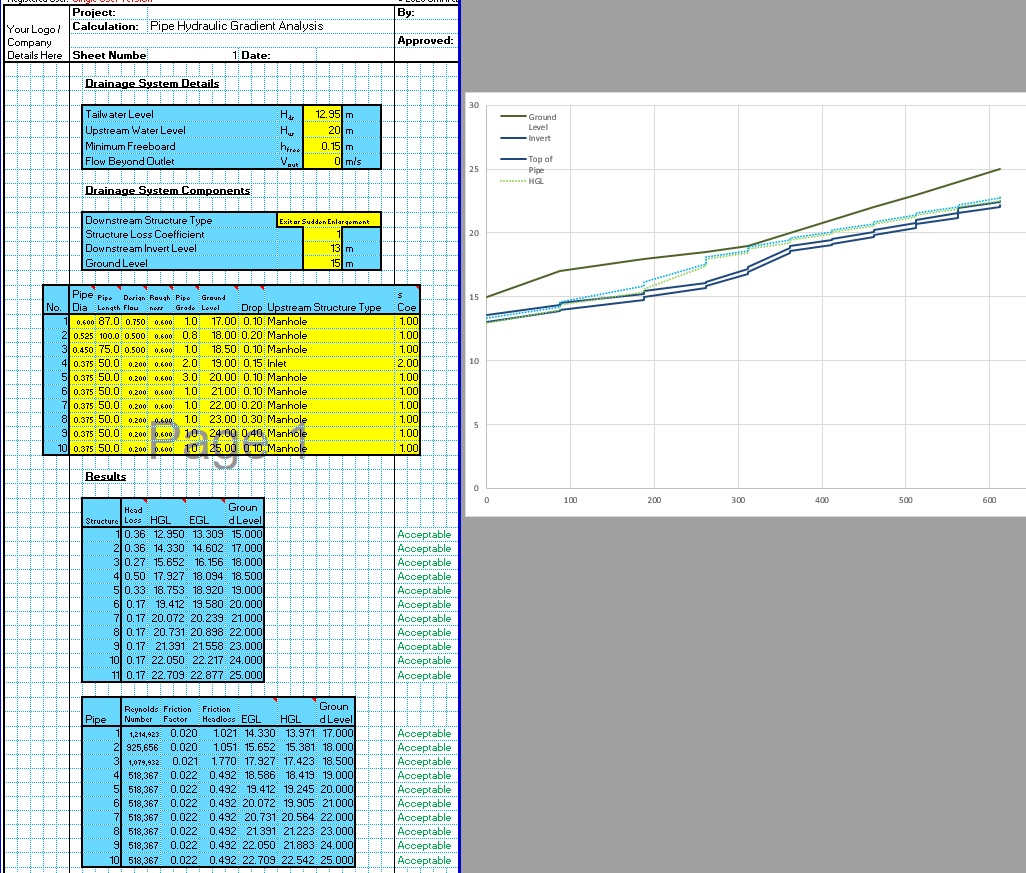
This spreadsheet analyses the hydraulic and energy grade lines for drainage systems with up to 10 drainage runs.
Learn More
Soakaway Design Spreadsheet
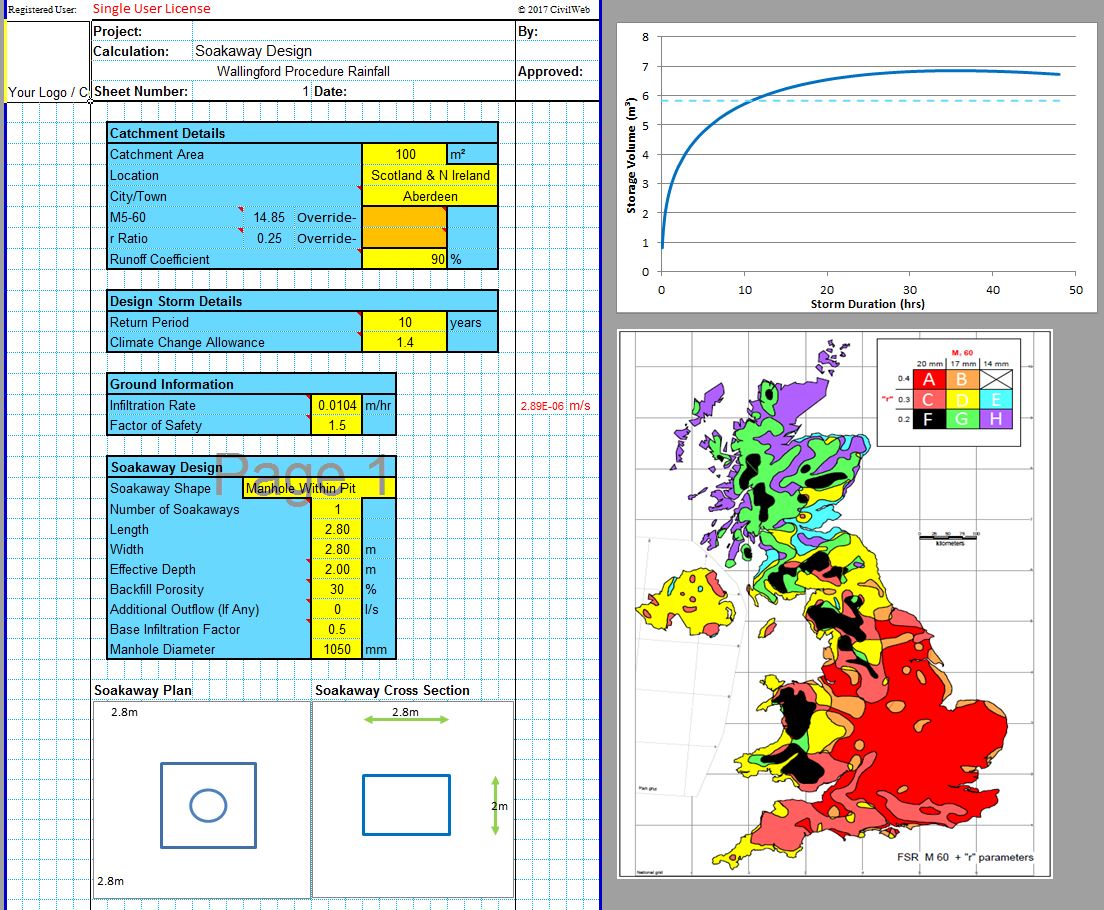
This spreadsheet calculates the requirements for a soakaway system and assists the user to design a suitable system.
Learn More
Concrete Protection Slab
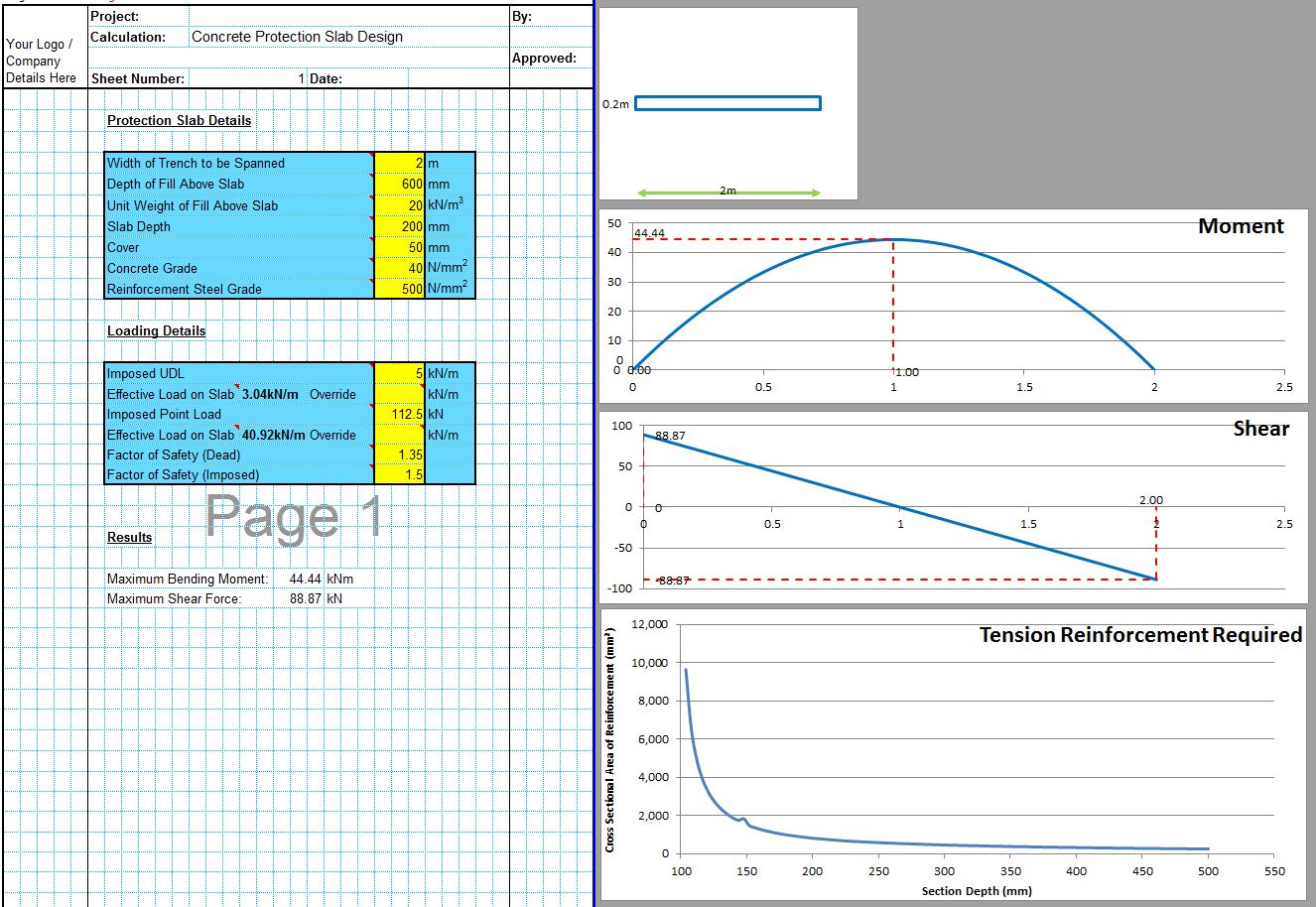
This detailed design spreadsheet designs a protection slab commonly installed to protect shallow pipes.
Learn More
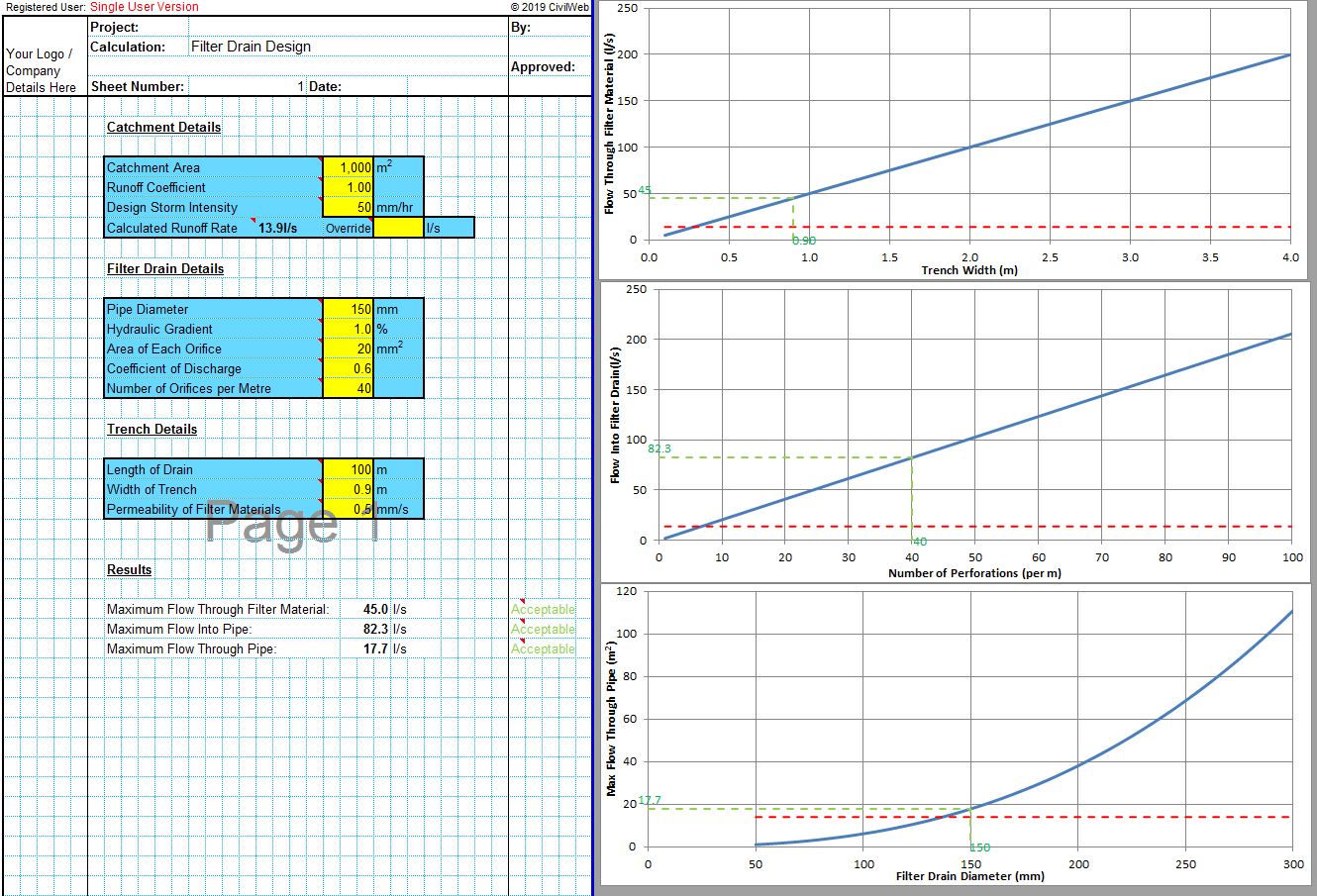
French Drain Design
This spreadsheet completes French Drain Design in accordance with the SUDS Manual.
Learn More
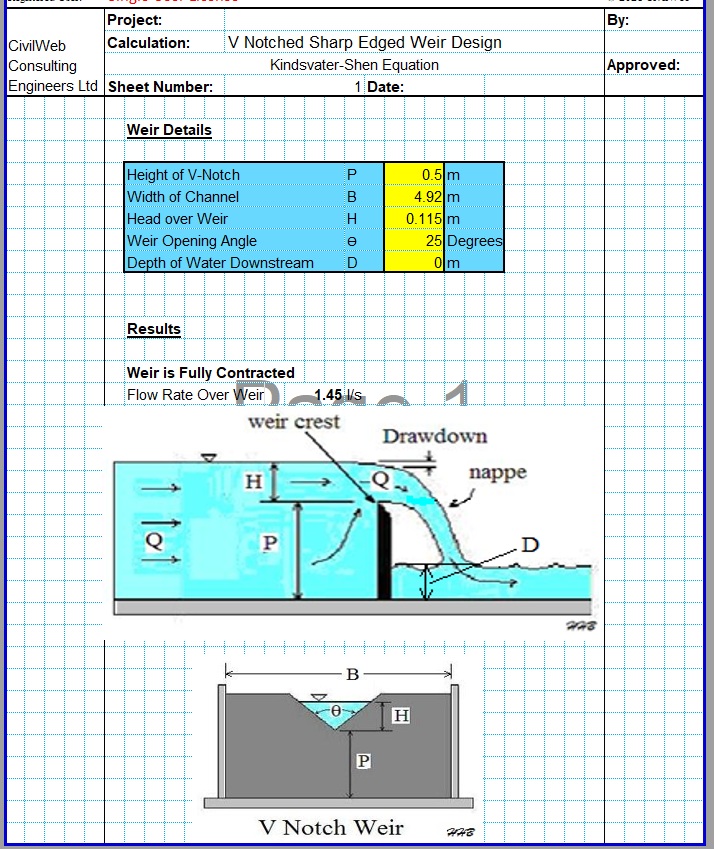
Sharp Crested Weir Flow Calculator Spreadsheets
This suite of 5 separate spreadsheets calculates the flow over sharp crested weirs of all shapes and sizes.
Learn More
Drainage Design Spreadsheet
This is the full suite of drainage design spreadsheets, available at a massive discount for only £49.99.